The Black Belt database serves as a high impact practice by engaging students in applied research, data analysis, and community focused problem solving that benefits rural communities. It also is a collaboration amongst USG institutions and public-private partnerships.
This database is made possible by the hard work of three interns Ava Dente (GCSU), Ganapathi Raman Deivanayagam (UGA) who both served as 2025 interns sponsored by the Partnership for Innovations (PIN). Jada Lane (GT) served as the 2025 summer intern sponsored by the Center for Sustainable Communities Research and Education (SCORE) at Georgia Tech. This database offers data visualization for the unique Black Belt region of Georgia, focusing on a select group of middle Georgia counties with Baldwin County home of GCSU, as the nucleus.
What is the Black Belt Region?
The Black Belt is a historically significant region of the southern United States. The term itself has a dual meaning, originally referring to the band of dark, fertile topsoil that stretches across several southern states. This geological richness made the area ideal for agriculture, particularly cotton cultivation, in the 19th century. Over time, the term also came to describe the demographics of the region, which became home to a large population of African Americans, initially brought to the area as enslaved labor to work on the plantations that drove the agricultural economy.
Geographically, the Black Belt arcs through states including Georgia, Alabama, Mississippi, and Louisiana, though its cultural and historical influence extends to areas of Virginia, Tennessee, the Carolinas, and Texas. The region’s identity was forged in the 19th century when its agricultural output was a primary driver of the national economy. The legacy of this period, including its unique demographics, economic challenges, and rich cultural heritage, continues to shape the social and political landscape of the American South today.
Table of Contents
1860 Agriculture
Map coming soon.
Farm
In 1860, the economy of the Black Belt region was fundamentally an agricultural one. Farming was of paramount importance, serving as the primary economic engine for its states. This agrarian society was characterized by significant regional specialization in crop production. For instance, wheat was most heavily produced by Virginia and Tennessee, while Florida produced the least. In contrast, rice cultivation was dominated by South Carolina and Georgia, with Virginia growing very little. This summary of regional farm production highlights a diverse and specialized agricultural landscape.
The economic and structural facets of the Black Belt’s farming system revealed stark contrasts. The value of land, a key indicator of agricultural wealth, varied dramatically; Louisiana’s farmland was the most valuable, averaging $22 per acre, while Texas had the least valued land at only $3 per acre. There were also notable differences in farm scale. In the 50-to-99-acre category, for example, Tennessee led with 22,829 farms, followed closely by Virginia with 21,145, while Florida had the fewest at 1,162. This data on farm values and sizes provides critical insight into the varied economic structures that underpinned the region’s agricultural identity before the Civil War.
Source: IPUMS NHGIS, University of Minnesota, www.nhgis.org.
1860 Demographics
Map coming soon.
Race and Population
In 1860, the demographic landscape of the Black Belt was defined by three main groups. The region was home to a white population of 8,036,700, an enslaved Black population of 3,521,110 and a smaller community of 226,152 free Black individuals. These figures from the “Grand Total” row of the data illustrate a deeply stratified society where the number of enslaved people constituted a significant portion of the overall population.
The regional population was not evenly distributed, with dramatic variation between the states. Virginia stood as the Black Belt region’s most populous state, with 1,596,318 residents. Florida was the least populous state, with a total of just 140,424 people. This disparity highlights the diverse settlement patterns and scales of agricultural enterprise that existed across the Black Belt before the Civil War.
Source: U. S. Census Bureau
2022 Georgia Agriculture
Map coming soon.
Farm
In 2022, Georgia’s agricultural sector remains a vital part of its identity and economy, a legacy of the aforementioned agricultural based economies of the 18th and 19th centuries. Today, the state of Georgia is home to 39,264 farms, which collectively cover an impressive 9,038,313 acres of land. This vast agricultural landscape is supported by Georgia’s two land-grant universities: the University of Georgia, established as the state’s original 1862 land-grant institution, and Fort Valley State University, designated as an 1890 land-grant institution. These universities are pivotal in blending the state’s deep agricultural roots with the cutting-edge technology needed for modern farming. This direct support helps the state’s nearly 40,000 farms manage challenges, improve yields, and contribute to Georgia’s robust food supply and significant role in the nation’s agricultural economy.
Most of Georgia’s farms today encompass between 10-200 acres, with 4,523,728 total acres in cropland. As of 2022, Georgia’s agricultural landscape includes 23,085 New and Beginning producers and 5,031 Young producers.
Source: USDA, National Agricultural Statistics Service 2022
2022 Georgia Demographics
Map coming soon.
Race and Population
In 2022, Georgia was home to a diverse and growing population of 10,912,876. The state’s demographic landscape is primarily defined by its two largest racial groups: the White population at 6,177,133 and the Black or African American population at 3,556,157. Georgia’s population is also enriched by an Asian population of 540,654, an American Indian and Alaska Native population of 99,634, and 539,298 other individuals.
Georgia’s residents also exhibit a range of educational and economic achievements. The state’s median household income was reported at $78,538, in 2023. The educational attainment of its citizens aged 25 and over, include a majority with at least a high school diploma at 89.5 percent, and those earning a bachelor’s degree at 35 percent.
Source: U. S. Census Bureau Quickfacts 2023, American Community Survey (ACS)
2022 County Agriculture
Map coming soon.
Farms
The agricultural landscape, in 2022 across the highlighted six Georgia counties, reveal significant variation in the scale and intensity of farming operations. Washington County stands out with the highest number of farms, highlighting 363 individual farm operations. In contrast, Baldwin County has the fewest farms, with just 113. This wide disparity in the number of regional farms highlights the diverse economic structures within the Middle Georgia region, from counties with a dense network of agricultural businesses to those with a more reliance on public and over sectors.
The data on land use further illustrates these differences in agricultural focus. Washington County not only has the most farms but also has the largest number of acres devoted to farming, with 97,770 acres of land, in farms. This indicates that farming is a dominant feature of the economic landscape of Washington County. Baldwin County has the smallest agricultural footprint, with only 25,183 acres in farms. This suggests that while agriculture is present within the county, it plays a less extensive role in the county’s overall land use compared to its regional neighbors.
Source: USDA, National Agricultural Statistics Service, 2022 Census of Agriculture
2022 County Demographics
Map coming soon.
Race and Population
In 2022, the demographic landscape across six key Middle Georgia counties in Georgia’s Black Belt region showcases a diverse range of population sizes and community structures. Among these, Baldwin County is the most populous with 43,776 residents. In stark contrast, Hancock County is the least populous with just 7,581 residents, illustrating a more rural character. This significant variation in population highlights the unique and distinct local identities and varying types of community life that exist within the region.
The racial composition of these counties reveals a complex and varied demography. Counties such as Jones and Putnam have majority White populations, making up over 70% of their respective totals. Conversely, other counties like Hancock and Washington have majority Black or African American populations, accounting for over 68% and 53% of their residents. This demonstrates that while the counties are all part of the historic Black Belt region, their individual demographic profiles are distinct, reflecting deep historical variations that continue to shape each community’s unique identity and economic outlook.
Source: U. S. Census Bureau Quickfacts 2024, American Community Survey (ACS)
County Demographics, Economics & Sustainability
Demographics
County Population by Race, 2024
County Population by Race estimates the percentage distribution of residents in the county across different racial and ethnic groups for 2024. These groups include: White, Black or African American, Hispanic, and Other racial groups.
Historically, Black Belt counties have had a predominantly Black or African American population. In 2024, the majority racial group in these six counties was either White – Baldwin, Jones, Putnam, Wilkinson – or African American – Hancock, Washington.
Source: Georgia Chamber Foundation, 2025 Economic Redbook
County Population by Age, 2024
County Population by Age estimates the distribution of county residents across different age groups (0-14, 15-24, 25-44, 45-64, 65+) in 2024. Age distribution provides insight into long-term demographic trends, such as aging populations, that may impact economic growth and the labor force in these counties.
In these six counties, the population is aging and concentrated in the 25-44 and 45-64 Years ranges. The smallest population in each of these counties is 0-14 Years and 15-24 Years, suggesting that the populations will continue to age in each of these counties. Source: Georgia Chamber Foundation, 2025 Economic Redbook
County Poverty Rate, 2021 to 2022
Poverty Rate estimates the percentage of individuals in the county whose income fell below the federal poverty threshold from 2021 to 2022. The poverty threshold, determined by the U.S. Census Bureau each year, varies based on household size and age composition.
High poverty rates are often linked to barriers in accessible housing, food security, affordable healthcare, quality of education and opportunities, and employment opportunities.
The poverty rate in each of these six counties was higher than the Georgia state average in 2022 (13.50%). Hancock, Putnam, Washington, and Wilkinson Counties showed decreases in their poverty rates, meaning less of the population was living in poverty. Baldwin and Jones Counties showed increases in their poverty rates, meaning more of the population was living in poverty.
Source: Georgia Chamber Foundation, 2025 Economic Redbook
Economics
Labor Force Participation by County, 2018 to 2023
Labor Force Participation by County estimates the percentage of the county’s population 16 Years and older that is employed or seeking employment from 2018 to 2023. Declining labor force participation indicates structural barriers including lack of job opportunities or skills mismatches. Unchanging or increasing labor force participation indicates increased engagement in employment or the introduction of new employment opportunities.
Statewide, Georgia’s labor force participation shrunk from 2018 to 2023 by -1.50%. Within these six counties, Baldwin, Jones, and Putnam Counties faced decreased labor force participation (-0.98%, -0.89%, -8.18%). Wilkinson County showed no change. Hancock and Washington Counties showed increases in their labor force participation (12.56%, 0.04%).
However, the labor force participation rate in all six counties in 2023 still fell below the state average (63.20%) and below the rural state average (59.30%).
Source: Georgia Chamber Foundation, 2025 Economic Redbook
Annual Private Employment
Annual Private Employment estimates the total number of jobs in the private sector and their average wages in the county throughout the year. The data has been divided into service-providing industry and goods-producing industry. The service-providing industry includes: trade, transportation and utilities, information, financial services, professional and business services, education and health services, leisure and hospitality, and other services. The goods-producing industry includes: natural resources and mining, construction, and manufacturing.
Source: Georgia Chamber Foundation, 2025 Economic Redbook; U.S. Bureau of Labor Statistics, Quarterly Census of Employment and Wages
Baldwin County
Baldwin County has experienced a slight decrease in their labor force participation rate (-0.98%) that coincides with a slight increase in the county’s poverty rate (0.10%). In combination with marginal population growth over the next fifteen years (less than 1,500 people), there is likely to be either marginal growth or no change in the number of private establishments or people employed by said establishments in the county.
Hancock County
Data for the service-providing industry and goods-producing industry was not available for Hancock County. Hancock County has the lowest amount of total private establishments out of the six counties and the largest poverty rate out of the six counties. Some signs of development in the county are showing (increase in labor force participation, decrease in the poverty rate), but the population is projected to shrink, so there will likely be limited growth in the number of private employers.
Jones County
Coinciding with a decrease in the labor force participation, Jones County experienced an increase of 0.10% in the poverty rate. However, their population is projected to grow in the next 15 years, so this may introduce a new workforce or new private establishments in the county.
Putnam County
As the population in Putnam County increasingly ages towards retirement, the labor force participation will decrease and may lead to businesses exiting the county in search of more active local workforces. However, the current aging population and decrease in labor force participation may be offset by the projected population growth over the next fifteen years.
Washington County
Despite having a higher number of natural resources and mining establishments in the county due to Kaolin mining (a mineral), the goods-producing industry is still outweighed by the service-providing industry. 75.03% of private employment in Washington County is through service-providing establishments. This proportion is not likely to change despite the decreasing poverty rate (-1.40%) and barely increasing labor force participation (0.04%). The population is projected to decrease slightly (less than 500 people).
Wilkinson County
Despite a notable decrease in the poverty rate in Wilkinson County (-4.20%), there has been no change in the labor force participation and a slight projected decrease in the population (less than 500 people). Combined, this will likely lead to no notable change in the annual private employment estimates.
Sustainability
Sustainability is about meeting the needs of the present without compromising the ability of future generations to meet theirs. Being sustainable, at both state and county levels, is more than just protecting the environment. It also means investing in communities. That’s why it’s important to look at sustainability initiatives that support both people and the planet.
Georgia's Key Industries
Georgia has 16 key industries that play a substantial role in the development and economic of the state. Agriculture is one of the key industries most prominent in the Black Belt region. There have been strides taken in all of these industries towards more sustainable practices.
- Agribusiness & Agriculture: Agriculture is the backbone of the region.
Some of the most intensive farming in Georgia takes place in its rural counties, especially those located in the Black Belt region. Counties like Thomas and Brooks lead in farmland acreage, while urban areas like Fulton County have much less due to dense development, high-rise buildings, and a focus on commercial industries. This contrast highlights the important role rural counties play in supporting Georgia’s agricultural economy. The Black Belt, in particular, has historically been most ideal for farming and has an extensive agricultural history. Despite their importance, many of these agriculture-heavy counties lack access to the resources, infrastructure, and policy support needed to thrive. Additionally, some are vulnerable to harmful industrial practices that negatively impact the land, putting long-term agricultural sustainability at risk.
Farms: Georgia is home to thousands of farms and farmers, a good portion of which sit in the Black Belt Region.
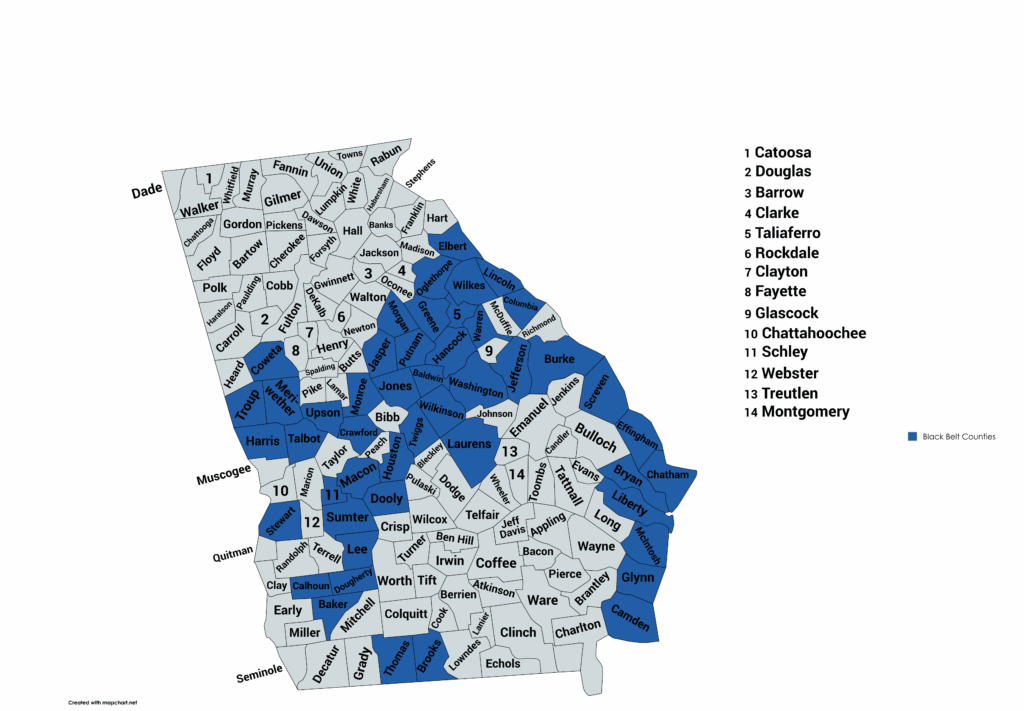
The map shown above highlights the Black Belt counties in Georgia in blue. Created with mapchart.net
These counties typically have a denser amount of farmland and less spread out/more protected natural amenities (i.e. forests, lakes). These are rural areas, so their locations are more ideal for farming. Still, the number of farms in Georgia has seen a decrease over the years. Georgia’s economy is shifting, but it is still important to maintain not only the farmland in the areas but also support the communities and all that these counties have to offer.

The map showcases the amount of farmland in acres in Georgia’s counties. The data was obtained from United States Department of Agriculture – National Agricultural Statistics Service (USDA NASS). Created with mapchart.net
Overlapping the two maps shown above will reveal that 67% of the counties with the largest amount of farmland (>200,000) are Black Belt counties. Additionally, it shows that 40 out of 48 of the Black Belt counties have greater than or equal to 25,000 acres of farmland in the county.
| County Breakdown | ||||||||
|---|---|---|---|---|---|---|---|---|
| <25,000 | 25,000 - 49,999 | 50,000 - 74,999 | 75,000 - 99,999 | 100,000 - 124,999 | 125,000 - 149,999 | 150,000 - 174,999 | 175,000 - 199,999 | >200,000 |
| Barrow Bibb Butts Camden* Catoosa Charlton Chatham* Chattahoochee Cherokee Clark Clayton Cobb Dawson Dekalb Douglas Fannin Fayette Forsyth Fulton Glynn* Gwinnett Henry Jefferson Liberty* Long* Lumpkin McIntosh* Muscogee Paulding Pickens Quitman Rabun Richmond Rockdale Spalding Stephens Taliaferro* Towns Warren Wilkinson* White | Baldwin* Ben Hill Bleckley Brantley Bryan* Clay Clinch Columbia* Crawford* Dade Echols Effingham* Emanuel Evans Gilmer Hall Habersham Hancock* Haralson Harris* Heard Jeff Davis Jones* Lamar Lanier Lincoln* Monroe* Murray Newton Oconee Pike Putnam* Schley* Talbot* Telfair Treutlen Troup* Twiggs* Union Upson* Whitefield | Banks Bartow Chatooga Coweta* Dougherty* Floyd Franklin Greene* Hart Houston* Jackson Jasper* Jenkins Johnson Marion McDuffie Montgomery Polk Pulaski Toombs Walton Ware Wayne Webster Wheeler | Atkinson Bacon Candler Carroll Cook Dodge Elbert* Gordon Lowndes Madison Meriweather* Morgan* Oglethorpe* Pierce Seminole Stewart Taylor Tift Turner Walker Washington* Wlcox Wilkes* | Appling Baker* Crisp Emanuel Grady Irwin Lee* Macon* Miller Randolph | Berrien Calhoun* Tattnall | Coffee Early Jefferson* Laurens* Screven* Sumter* Terrell | Bulloch Colquitt Decatur | Brooks* Burke* Dooly* Mitchell Thomas* Worth |
| *Black Belt Counties | ||||||||
This table shows the data that is highlighted on the map. The counties with an asterisk (*) beside them are Black Belt counties. The numbers shown in the bottom row are the total number of Black Belt counties within each data range.
Forestry: Georgia is one of the top Forestry states in the nation, which is extremely important for economic development. The state’s forests are also very important for keeping Georgia’s annual emissions in check. According to research done by the Georgia Climate Project, Georgia’s forests sequester, or absorb, enough carbon to offset 23% of the state’s annual emissions.
The table below shows the emissions for 6 Black Belt counties from the years 2005, 2015, and 2014. An important thing to note about these counties is that in every one of those counties, forestry is what helps to reduce the emissions. This data was obtained from Drawdown Georgia – Emissions Tracker, which is a database that allows you to explore the emissions of Georgia’s counties through the years and the different industries that impact the numbers. The data further represents the past, present, and future importance of Georgia’s forestry sector.
| County | Annual Emissions (in metric tons) – 2005 | Annual Emissions (in metric tons) – 2015 | Annual Emissions (in metric tons) – 2024 |
|---|---|---|---|
| Baldwin | 508.1K | 346.0K | 107.9K |
| Hancock | -249.6K | -320.9K | -127.5K |
| Jones | -20.7K | -100.2K | -57.2K |
| Putnam | 121.2K | 5731 | 25.5K |
| Washington | 16.2K | -100.8K | -41.1K |
| Wilkinson | 303.0K | 211.5K | -34.2K |
For all the counties listed above the emissions between 2015 and 2024 saw an increase rather than a decrease. This could be due to a multitude of reasons, one being more development in these counties, yet even still all these counties remain in the “green” or better in terms of carbon emissions. See the image below for how the Georgia Drawdown ranks or color codes the range of emissions.
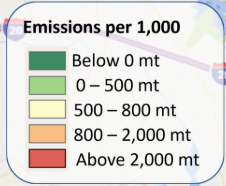
Image obtained from Drawdown GA – Emissions Tracker.
Statewide Programs & Networks
Listed below are just a few state programs that address threats to Georgia’s environments and/or impacts on communities through actively working in every Georgia county or maintaining connections across the state.
- University of Georgia (UGA) Extension: The UGA Extension provides education, research-based resources, and outreach through its county offices, focusing on agriculture, environment, community development, and youth. It helps communities adopt environmentally sound practices by offering hands-on guidance in areas like soil health, water use, food systems, and climate-smart agriculture.
- Georgia Manufacturing Extension Project (GaMEP): GaMEP is a Georgia Tech program that helps manufacturers across the state become more competitive through innovation, productivity, and sustainability. It drives greener production across Georgia by helping factories streamline operations, cut waste, and use resources more efficiently without sacrificing output.
- Georgia Conservancy: This is a nonprofit organization advocates for environmental protection through land conservation, sustainable growth, and environmental education. It strengthens Georgia’s environmental future by advancing conservation and sustainable development policies that balance growth with ecological protection.
- Georgia Land Conservation Assistance Network: This network is an online resource hub providing information on land conservation tools, funding, and service providers to landowners, organizations, and agencies. It empowers landowners to protect ecosystems and working lands through access to conservation resources, technical help, and funding opportunities.
- Georgia Environmental Protection Division: This is the state agency responsible for protecting Georgia’s air, land, and water through environmental permitting, monitoring, and enforcement. They lead statewide efforts to safeguard natural resources by enforcing environmental laws, addressing pollution threats, and promoting climate readiness in local planning.
- Georgia Department of Economic Development: This state department is responsible for promoting business, tourism, film, and global commerce in Georgia. They boost sustainability by supporting eco-conscious industries, encouraging innovation in clean tech, and integrating environmental goals into economic plans.
County Initiatives:
Each Georgia county has their own departments, programs, and projects – some which may overlap – that help contribute to sustainable development in these counties.
Baldwin County
- Electric School Bus Program: In 2024, Baldwin County received a $2 million grant for purchase of electric school buses. The implementation of these buses would help to reduce emissions and save additional money for the county.
- Blight Reduction Program: This program is a county initiative to encourage renovation or demolition of over 300 dilapidated properties to improve neighborhood health and appearance.
- Live Healthy Baldwin: This initiative is a community-wide campaign tackling childhood obesity by improving access to healthy foods and encouraging active transportation (e.g. bike paths).
Hancock County
- Sweet Magnolia Solar (Proposed): AES, an energy company dedicated to helping the world transition to renewable energy, has plans for a solar farm south of Devereux community in Hancock County. This project would contribute toward Georgia’s renewable energy goals.
- Sparta-Hancock County Historic Preservation Commision: The SHHPC supports preservation projects in Sparta. DREAM Streets Sparta is a historic preservation-led streetscape revitalization program that also enhances environmental quality. The program is aided by the commission.
Jones County
- Keep Jones Beautiful: This is a local affiliate of Keep America/Georgia Beautiful focused on planting trees, maintaining parks, installing recycling centers, and enforcing litter ordinances.
- Environmental Code Enforcement: The Jones County Environmental Code Office enforces solid waste ordinances, oversees recycling centers and logging activity, and provides public education.
- Jake’s Woods Greenspace Acquisition: Jake’s Woods Boulder Field is now a protected 28-acre site preserved in a collaborative effort with The Conservation Fund and funded by Georgia Outdoor Stewardship Grants.
Putnam County
- Solar Energy: Putnam County is taking part in the SolSmart program, a U.S. Department of Energy initiative that helps communities remove obstacles to solar power and support solar energy for homes and businesses.
Washington County
- Forestry: Washington County is dedicated to highlighting and working to conserve the abundance of forestland. There are many opportunities to be identified thanks to this precious resource.
- Economic Development (Sandersville): The Economic Development Department in Sandersville is dedicated to promoting and supporting growth and sustainability of businesses both large and small. The department aims to promote economic growth, support affordable living for the community, and assist in revitalizing areas in need in Sandersville.
Wilkinson County
- Public Sewer Expansion in McIntyre: In 2023, a project to update sewer infrastructure and replace septic systems to improve water and environmental health came into fruition. The completed expansion will help the town to mitigate some environmental and public health risks that exist within the community.
- Land Acquisition for Sustainable Development – The Freedom Georgia Initiative: 19 families came together to purchase nearly 100 acres of land with hopes of developing a “safe haven” for Black people. Additionally, the vision for the project is to develop a safe and innovative community for “environmentally sustainable-living, health & wellness, agricultural & economic development, and arts & culture” (The Freedom Georgia Initiative).
Natural Amenities
Diverse natural amenities remain a core characteristic of the Black Belt Region. From gorgeous rivers and lakes to vast hunting grounds, there is natural beauty throughout each county in the region. However, these natural areas are not widely known as tourist destinations. In these six counties, there are many places perfect for outdoor recreation and tourism. These natural amenities are central to the identity of the Black Belt Region and its assets.
County Destinations
Multi County
- Lake Sinclair, located in Baldwin, Hancock, and Putnam Counties, is one of the most prominent natural amenities within these six counties. This lake is ideal for water activities, such as fishing, boating, and kayaking, as well as lakeside activities, including picnicking and camping. With calm waters and breathtaking natural views, Lake Sinclair is the perfect destination for tourists and residents year-round.
Just east of Lake Sinclair lies Lake Oconee in Hancock and Putnam Counties. Lake Oconee is larger and more developed than Lake Sinclair, with upscale resorts and a wide variety of recreational activities on and off the water. Visitors can go fishing, boating, jet skiing, and more on the water. Off the lake, there are well-maintained golf courses and picnicking and camping areas.
Oconee Wildlife Management Area
Located in Hancock and Putnam Counties, the Oconee Wildlife Management Area boasts thousands of acres of forested land. This destination is perfect for hunting, hiking, fishing, and nature exploration. Under the management of the Georgia Department of Natural Resources, the ecologically diverse land is preserved and provides a habitat for the wildlife in the area.
Cedar Creek Wildlife Management Area
In Putnam and Jones Counties, the Cedar Creek Wildlife Management Area spans thousands of acres. With opportunities to hunt, shoot, hike, and camp, this area is perfect for outdoor enthusiasts. The Cedar Creek WMA supports a wide range of wildlife and diverse forestry within its bounds.
Chattahoochee-Oconee National Forest, Oconee Ranger District
The Chattahoochee-Oconee National Forest, Oconee Ranger District, stretches through parts of Jones and Putnam Counties. This forest, which is Georgia’s only national forest, provides breathtaking views of lakes and streams, rolling hills, sprawling forests, and diverse wildlife. The Oconee Ranger District supports regulated hunting and fishing, picnicking and camping, hiking, biking, and numerous water activities. Visitors can go boating, canoeing, kayaking, and white water rafting in this portion of the Chattahoochee-Oconee National Forest.
Another must-see natural beauty in the region is Hamburg State Park. Located in Washington and Hancock Counties, there are opportunities for fishing, boating, and paddling as well as areas to bike, hike, and camp. Hamburg State Park also is home to a restored 20th century water-powered mill that offers a glimpse into the area’s agricultural history.
Baldwin County
The Oconee River Greenway offers access to wooded paths, open green spaces, and river views in the center of Milledgeville. With its natural and paved trails, boardwalks, fishing docks, and river access, the Greenway serves as a natural space for both recreation and relaxation.
Rocky Creek Park is one of the most popular access points in Baldwin County to Lake Sinclair. This park is open seasonally and features sheltered areas for picnicking and grilling alongside the lake. In addition to relaxation, there is also a swimming beach, public boat ramp and fishing pier for recreational opportunities outdoors.
Just minutes away from downtown Milledgeville, the Selma Erwin Nature Preserve features 88 acres of forested trails. These trails are ideal for biking, hiking, fishing, and nature observation. This preserve provides an opportunity to enjoy the Black Belt Region’s natural beauty in a more secluded setting.
Harrisburg Park
Harrisburg Park is a community-focused park that hosts a range of outdoor amenities, including walking and biking trails, playgrounds, athletic fields, a splash pad, and open green spaces. With its opportunities for both recreation and relaxation, this park is a popular gathering spot for the community and its families.
Located in Milledgeville, Walter B. Williams Park is one of Baldwin County’s largest and most versatile public parks. This park features athletic fields, playgrounds, tennis and pickleball courts, walking trails, a fishing pond, and open green spaces. Also included in this sprawling park is a disc golf course, an 8-mile cross country and mountain biking trail, and a brand-new waterpark. With its well-maintained facilities and variety of outdoor recreational opportunities, Walter B. Williams Park is a great space to enjoy nature for people of all ages.
Bartram Forest Wildlife Management Area
Bartram Forest Wildlife Management Area boasts over 1,300 acres of forestry. Once a state tree nursery, Bartram Forest now contains a network of trails ideal for hiking and biking, observing nature, and fishing. This site is managed and preserved by the Georgia Department of Natural Resources, providing a beautiful natural space for everyone to explore.
Lockerly Arboretum is an amazing green space to visit. With walking trails, a pond, diverse plant collections, and the historic Rose Hill mansion, this garden is both a recreational and educational opportunity. Visitors can stroll through the gardens, which are decorated for the Christmas season in the wintertime.
Andalusia, the historic home of author Flannery O’Connor, is open to the public for touring. Visitors can tour the farmhouse, explore the grounds, and experience the natural beauty of the region. Now managed by Georgia College & State University, Andalusia offers a blend of literary history and natural scenery.
Deep Roots Festival
Each year the Deep Roots Festival is held in downtown Milledgeville. This festival features a variety of food, beverage, and arts and crafts vendors, a classic car show, and live music. Drawing thousands of visitors of all ages each year, this festival displays the rich culture of the region.
Hancock County
Held annually in the town of Sparta, the Pinetree Festival celebrates the area’s rich forestry history and honors the county’s natural resources. The festival features an exciting parade, live music, food vendors, arts and crafts vendors, and activities for all ages.
Jones County
Piedmont National Wildlife Refuge
The Piedmont National Wildlife Refuge is a vast natural sanctuary. Originally established to restore damaged farmland, the refuge now is a habitat for diverse plant and animal species. Visitors can explore hiking trails, observe the wildlife, or participate in regulated hunting and fishing. The Piedmont National Wildlife Refuge offers scenic views and great opportunities to explore nature.
Jarrell Plantation Historic Site
Jarrell Plantation Historic Site is home to a well-preserved 19th-century cotton plantation. Operated by the same family for over 140 years, this historic site offers a glimpse into rural life before and after the Civil War. Visitors can tour the grounds and the buildings on it, including the plantation house, sawmill, syrup mill, and blacksmith shop. The site offers historic exhibits and trails to guide guests, blending nature and history. Visitors can also explore nearby Griswoldville Battlefield, a Civil War battlefield and memorial.
Putnam County
B.F. Grant Wildlife Management Area
Spanning over 11,000 acres, this area is both a research forest for the University of Georgia and a public recreation site managed by the Georgia Department of Natural Resources. B.F. Grant WMA offers opportunities for hiking, hunting, fishing, and wildlife observation. This area is home to a variety of species, including deer, turkey, and migratory birds.
Located on Lake Oconee in Eatonton, this park and campground offers a full range of outdoor amenities, including RV and tent camping sites, cabin rentals, a swimming beach, a seasonal waterpark, and boat rentals. Visitors can fish from the shore, go paddleboarding or kayaking, and relax in the pavilions. Oconee Springs Park is perfect for weekend adventures on the lake.
The town of Eatonton hosts the annual Dairy Festival to celebrate Putnam County’s proud heritage as Georgia’s Dairy Capital. Held each June, the festival includes a parade, 1-Mile, 5K, and 10K runs, live music, local food vendors, arts and crafts, and a dairy exhibition. This festival blends the agricultural heritage of the region with exciting events for all ages.
The “Peg Leg” Howell BBQ & Blues Festival
Held annually to honor the legacy of blues legend “Peg Leg” Howell, the festival blends delicious BBQ, live blues music, and local arts and crafts. Celebrating both the cultural heritage and culinary traditions of the region, this festival is a thrilling event in Eatonton.
Washington County
For outdoor enthusiasts and disc golf players, Depot Disc Golf is a well-maintained course through wooded areas and open fields. Located near downtown Sandersville, this course is a great way to enjoy the outdoors while having fun.
Located in Sandersville, the Washington County Ag Center supports local farmers, gardeners, and visitors interested in sustainable agriculture. The center offers educational programs, workshops, and resources focused on sustainable agriculture. The center also hosts community events, farmers’ markets, and youth activities to promote the area’s agricultural heritage. In April, the Washington County Ag Center hosts a rodeo.
The Kaolin Festival is held annually in Sandersville to celebrate the region’s rich history as the “Kaolin Capital of the World.” The festival honors the mining and processing of kaolin clay, a key natural resource found in Washington County. Events include a parade, food vendors, arts and crafts vendors, car shows, mine tours, and live entertainment.
Held in the town of Tennille, the festival celebrates the culinary traditions of BBQ in Georgia. Featuring delicious barbecue from local food vendors, live music, arts and crafts vendors, and activities for children, this festival is a staple community event.
Wilkinson County
Located along the Oconee River, Ball’s Ferry offers outdoor recreational opportunities, including fishing, camping, and kayaking. Once a key river crossing during early settlement in Georgia, this nature site is now a peaceful destination for nature lovers and history enthusiasts.
Beaverdam Wildlife Management Area
The Beaverdam Wildlife Management Area contains over 7,000 acres of diverse land for outdoor recreation and conservation. Managed by the Georgia Department of Natural Resources, this area supports a variety of native wildlife and game species. Visitors can go hunting, fishing, hiking, and camping in the forests, fields, and streams.
State Banana Pudding Festival of Georgia
Held annually in Irwinton, the State Banana Pudding Festival of Georgia is a delicious event with a weekend full of food and entertainment. Visitors can sample banana pudding recipes from local food vendors, participate in pudding-themed contests, enjoy live music, and explore arts and crafts vendors.
Thank you to our partners and creators!
Without them, this research would not be possible. Learn more about our partners and creators.